
Trade show displays are often your first—and sometimes only—chance to capture attention, start conversations, and generate qualified leads at an event. Yet many companies invest heavily in space and travel, then underperform because their booth simply doesn’t convert. The difference between a forgettable presence and a high-ROI show often comes down to strategy-driven design, not just “looking cool.”
This guide breaks down proven booth design secrets to help you build trade show displays that consistently attract, engage, and convert the right visitors.
Start With Strategy: Define What “Conversion” Means for Your Booth
Before choosing graphics, lighting, or giveaways, get clear on what success looks like.
Common conversion goals for trade show displays include:
- Scanned badges / new leads
- Booked demos or meetings
- On-the-spot sales or pre-orders
- Newsletter signups
- Partner or distributor inquiries
- Brand awareness and content engagement
Pick one primary goal and one or two secondary goals. Then design every part of your display—messaging, layout, staff roles, and interactions—to support those priorities.
Tip: If your main goal is demos, the booth should prioritize open demo stations and seating. If it’s lead volume, you’ll need easy, fast ways to capture info and move people through.
The 3-Second Rule: Clarify Who You Are and Why They Should Care
Attendees often scan aisles quickly, giving each booth just a few seconds of attention. Your trade show displays must pass the “3-second rule”:
Within three seconds, a passerby should be able to answer:
- What do you do?
- Who is it for?
- Why should they care?
To achieve this:
- Use a clear headline on your backwall, not your company name, as the largest text.
- Avoid jargon. Focus on benefits/results instead of features.
- Include visual cues (icons, images, or short phrases) that signal your industry or use case.
Weak headline:
“Next-Gen Cloud Solutions”
Strong headline:
“Cut Your Cloud Costs by 40%—Without Changing Your Stack”
The second version instantly communicates value and sparks curiosity—perfect for busy trade show floors.
Design Fundamentals: Visual Hierarchy That Pulls Visitors In
Trade show displays that convert use visual hierarchy to guide eyes and attention.
1. Prioritize a Single Core Message
Too many booths try to say everything and end up saying nothing clearly. Pick one core promise or outcome and make that the star.
- Largest text: Core benefit-driven headline
- Secondary text: Sub-headline clarifying who it’s for or how it works
- Supporting text: Brief bullet points, not paragraphs
2. Place Key Messages at Eye Level and Above
Crowds can block lower areas of your booth. Keep your main message and visuals:
- At about 5–7 feet high on the backwall
- On hanging signs if possible
- On side panels facing aisle traffic
3. Use Clean, On-Brand Design
- Limit fonts to 2 typefaces, 3 weights.
- Use high-contrast colors for legibility.
- Avoid overly busy backgrounds behind important text.
- Use large, simple images that are readable from a distance.
When in doubt, simplify. White space (or negative space) is your friend—it makes important content stand out.
Layout Secrets: Make Your Booth Easy to Enter, Not Easy to Avoid
A great visual message will fail if your layout feels cramped, confusing, or unwelcoming. Smart layout is one of the biggest differentiators between average and high-performing trade show displays.
Avoid the “Barricade” Booth
A common mistake: putting a big table or counter across the front, forcing staff to stand behind it like a wall. This creates distance and subtly tells people to stay out.
Instead:
- Keep the front of the booth open.
- Move counters and tables to the side or back.
- Use rugs, flooring, or lighting to “invite” people in and define zones.
Create Clear Zones for Different Types of Visitors
Design your space for 3 types of engagement:
-
Drive-by visitors
- Need a quick impression (3–10 seconds)
- See your main message, visuals, and maybe grab a flyer or scan a QR code
-
Interested visitors
- Spend 2–5 minutes
- Want a short conversation or quick demo
- Use standing demo stations or high-top tables
-
Qualified prospects
- Spend 5–20 minutes
- Need deeper conversations, pricing talk, or multiple stakeholders present
- Provide seating, semi-private meeting space, or a quiet corner
By intentionally planning for each, your booth feels organized instead of chaotic.
Lighting, Color, and Motion: Subtle Tweaks, Big Impact
Small environmental changes can dramatically increase traffic and dwell time.
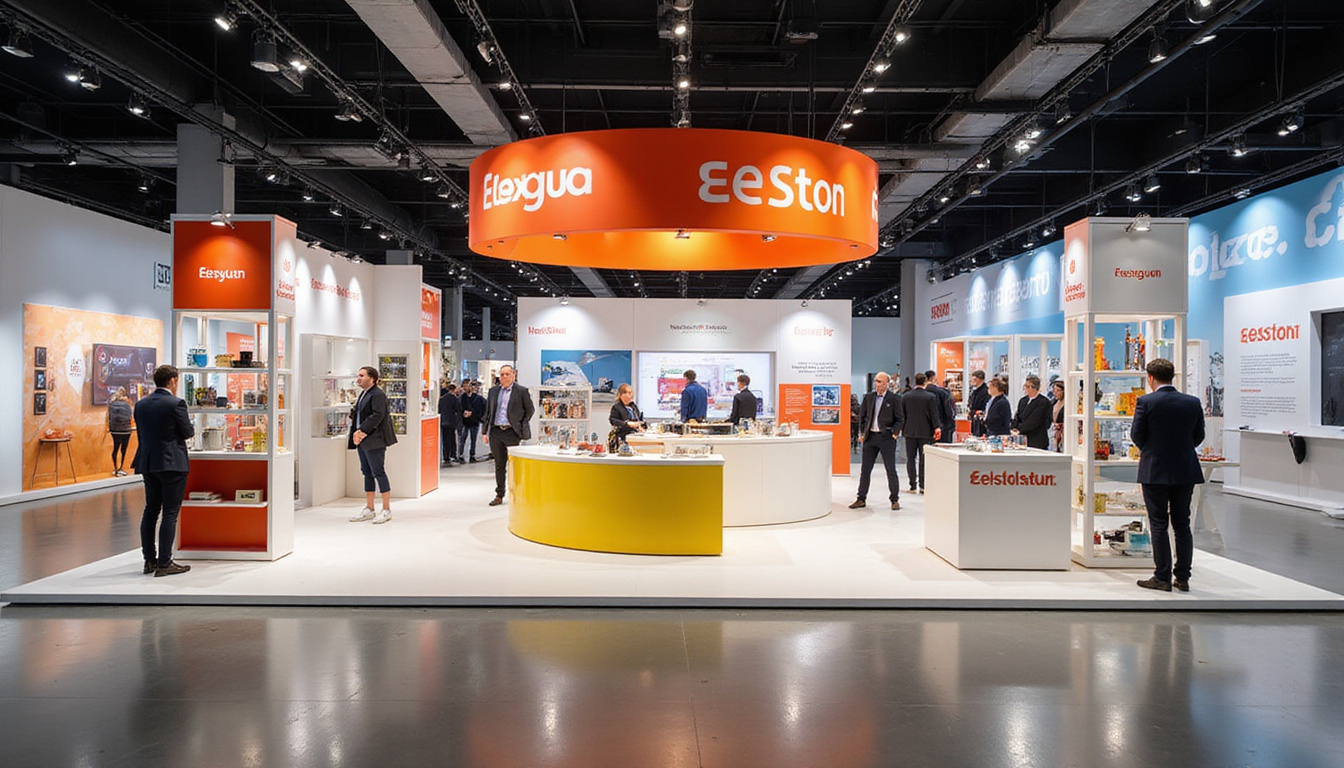
Use Lighting to Direct Attention
- Highlight your main headline and key product area.
- Use spotlights on hero products or demo stations.
- Consider backlit graphics for a modern, high-impact look.
Good lighting not only improves aesthetics but also helps your display visually “pop” in a crowded hall.
Choose Colors Strategically
- Align with your brand—but consider contrast with typical hall colors (often gray, blue, or neutral).
- Use a bold accent color sparingly to draw attention to CTAs or key elements.
- Ensure text/background contrast meets basic accessibility standards for readability.
Use Motion Intelligently
Digital screens, looping videos, or interactive elements can attract eyes—but only if they’re purposeful:
- Keep videos short (30–90 seconds) and silent-friendly (text captions, visuals).
- Feature real product use, customer results, or animated explanations—not just logo loops.
- Avoid overwhelming strobes or fast-flashing content that can feel aggressive.
Messaging That Converts: What to Say (and What to Skip)
The content on your trade show displays must do three things fast: attract, qualify, and invite.
Focus on Outcomes, Not Just Features
Turn features into benefits:
- “AI-powered workflow automation” → “Automate manual tasks and reclaim 10+ hours per week”
- “24/7 support” → “Get expert help whenever you need it—without waiting”
Use Social Proof Wherever Possible
Attendees are more likely to engage when they see proof others trust you:
- Logos of well-known clients
- Short testimonial quotes
- Metrics: “Used by 3,000+ retailers” or “Cuts onboarding time by 60%”
Even a single, powerful proof point can boost perceived credibility.
Always Include a Clear Call to Action
Don’t assume people know what to do next. Prominent CTAs might be:
- “Book a 5-minute live demo”
- “Scan to get our buyer’s guide”
- “Enter to win [relevant prize]—it takes 30 seconds”
Make calls-to-action visible both on signage and on screens or printed materials.
Interactivity: Turn Passive Browsers into Active Prospects
Engagement dramatically improves retention and conversions. According to industry data, interactive experiences at booths can significantly increase lead quality and memorability (source: Center for Exhibition Industry Research).
High-Impact Interactive Ideas
- Live demos with real data or realistic scenarios
- Touchscreens or tablets with self-guided tours, calculators, or configurators
- Product samples visitors can test, touch, or try on
- Mini-workshops or micro-sessions on a schedule (e.g., “3-minute teardown of your marketing funnel”)
Keep interactions short and meaningful—most visitors don’t want to be stuck in a 20-minute pitch.
Staffing and Flow: Design for Conversations, Not Crowds
Even the best-designed trade show displays can’t compensate for poor staffing. Design and staff strategy must work together.
Position Staff Strategically
- Place at least one person near the front edge of the booth to greet passersby.
- Keep some team members free from demos at all times for quick chats.
- Avoid “clumping” where staff huddle together talking—it signals that visitors are interrupting.
Give Staff Simple Opening Lines
Make it easy for your team to start conversations without sounding pushy:
- “What brought you to the show today?”
- “Which [role/industry/product type] are you focused on?”
- “Have you heard of [your company] before, or should I give you the 10-second version?”
Train them to quickly qualify visitors and direct them to the right area or activity.
Lead Capture: Design for Follow-Up From the Start
If your trade show displays are generating interest but you’re not effectively capturing and organizing leads, your ROI will suffer.
Make Lead Capture Frictionless
- Use badge scanners or lead capture apps on tablets/phones.
- Pre-build categories or tags (e.g., hot/warm/cold, persona, timeline).
- Offer a clear reason to share info: a resource, giveaway, pricing, or exclusive demo.
Design Visual Prompts for Lead Capture
Incorporate prompts into your physical design:
- Signs: “Scan your badge for the full case study library”
- Tabletop displays: “Drop your card to get the ROI calculator”
- QR codes on graphics leading to a short form or landing page
Pre-Show and Post-Show: Extend the Impact of Your Display
The most effective trade show displays are part of a larger marketing system, not standalone events.
Before the Show
- Email your list and prospects with your booth number and a clear reason to visit.
- Offer to pre-book demos or meetings.
- Share teaser photos or renders of your booth on social media and event channels.
After the Show
- Follow up within 24–72 hours while memories are fresh.
- Segment leads based on their interest level and conversations.
- Reference something from the booth interaction (“You saw our live fulfillment demo…”).
Your display attracted them; your follow-up converts them.
Quick Checklist: Elements of High-Converting Trade Show Displays
Use this list to evaluate your current or planned booth:
- One clear, benefit-focused headline visible from the aisle
- Visual hierarchy that makes next steps obvious
- Open, welcoming layout with no front “barricade”
- Defined zones for quick visitors, demos, and deep conversations
- Good lighting and contrast that highlight key areas
- Interactive element(s) tied to your core value prop
- Social proof visible on graphics or screens
- Prominent, specific calls to action
- Fast, simple lead capture tools integrated into the flow
- Trained, approachable staff positioned to engage
FAQ About Trade Show Displays and Booth Design
Q1: What makes trade show displays effective for lead generation?
Effective trade show displays combine clear messaging, open layouts, and easy lead capture. They quickly communicate who you serve and the problem you solve, use compelling visuals and social proof to build trust, and guide visitors toward demos, signups, or conversations without friction.
Q2: How can I improve my trade show booth display on a small budget?
Focus on fundamentals: sharpen your headline and messaging, declutter your graphics, add better lighting, and redesign your layout to be more open. Even with a basic structure, small investments in updated banners, a clean backwall, a TV loop, and a strong call to action can significantly improve results.
Q3: What types of trade show booth designs work best for small spaces?
For 10×10 or 10×20 booths, prioritize vertical space and openness. Use a strong backwall with a single core message, slim side counters, and one main interactive element (like a demo station or touchscreen). Avoid large furniture that blocks entry—compact, modular trade show displays with integrated storage and lighting work especially well in tight footprints.
Designing trade show displays that truly convert isn’t about having the flashiest booth—it’s about aligning strategy, messaging, layout, and staffing around clear goals. When your display instantly communicates value, feels easy to enter, and makes next steps obvious, you’ll stand out from competitors and turn more of that expensive foot traffic into real business.
If you’re ready to rethink your next trade show presence, start now: map your goals, sketch a more open layout, and rewrite your primary headline. Then, consider partnering with an experienced exhibit designer or vendor who understands conversion-focused trade show displays and can translate your strategy into a high-impact, on-brand booth. Your next show doesn’t have to be a gamble—it can be your most profitable event of the year.