
For local businesses competing in a crowded marketplace, print distribution is still one of the most effective ways to get in front of nearby customers. While digital marketing gets most of the attention, smart, data-driven print campaigns can drive real-world foot traffic, build trust, and generate measurable sales—especially when coordinated with your online presence.
Below is a practical, people-first guide to building a print distribution strategy that actually moves the needle for your local business.
Why print distribution still works for local businesses
Despite the growth of digital channels, print remains powerful for three key reasons:
- Local relevance: Physical materials—flyers, door hangers, menus, postcards—reach people where they live and shop, making messages feel immediately relevant.
- High trust factor: Print is often perceived as more credible and established than digital-only ads, especially for local service providers.
- Tangible, longer-lasting impact: Printed pieces can sit on kitchen counters, fridges, and office desks for days or weeks, offering repeated exposure.
Studies from organizations like the Data & Marketing Association have shown that direct mail response rates frequently outperform many digital formats, particularly for local audiences (source: Data & Marketing Association).
Start with clear goals and a defined local audience
Before you print a single piece, define what you want your print distribution campaign to achieve.
Clarify your primary goal
Common objectives include:
- Increasing walk-in traffic
- Promoting a grand opening or new location
- Launching a new product or service
- Driving calls or bookings
- Growing your email or SMS list
- Building neighborhood awareness
Your goal will influence the design, message, and where you choose to distribute.
Define your ideal local customer
Be specific about:
- Location: Neighborhoods, ZIP codes, or radius around your store
- Demographics: Age, income level, family status, lifestyle
- Needs and triggers: What problem do you solve, and what motivates action?
For example, a local gym might focus on apartments within a 2-mile radius, targeting young professionals and offering a new-member discount valid for nearby residents only.
Choose the right print formats for your business
Not every print format suits every business. Select materials that match your brand, budget, and goals.
Common print distribution formats
- Flyers: Cost-effective, versatile; ideal for limited-time offers and events.
- Postcards: Great for targeted mailing lists and strong visual branding.
- Door hangers: Effective for hyper-local promotion (e.g., home services, restaurants).
- Brochures: Best for higher-consideration services (e.g., clinics, financial advisors).
- Menus or service lists: Perfect for restaurants, salons, and service providers.
- Coupon books or vouchers: Powerful for first-time customer acquisition.
- In-store handouts: Inserts in shopping bags or receipts to encourage return visits.
Match the format to how quickly you need action. Flyers and postcards are ideal for “act now” offers, while brochures are better for educating and nurturing interest.
Smart print distribution channels for local reach
1. Door-to-door distribution
Physically placing print materials at homes in your service area is one of the most direct tactics.
Options include:
- Door hangers in targeted neighborhoods
- Flyers left in mail slots or under doors (follow local regulations)
- Community mailbox areas (where permitted)
Best for: Restaurants, cleaning services, landscapers, gyms, local retailers, and tradespeople.
Tips:
- Time campaigns around seasonal needs (e.g., HVAC check-ups before summer/winter).
- Use clear, bold offers and expiration dates to spur faster response.
- Don’t blanket every area—target the neighborhoods most likely to convert.
2. Direct mail campaigns
Direct mail is a more structured form of print distribution, often using the postal service’s tools for targeting.
You can use:
- Every Door Direct Mail (EDDM): Blanket specific carrier routes without needing a mailing list—useful for new locations or broad awareness.
- Addressed mail: Use purchased or in-house customer lists for more precise targeting (e.g., high-income households for premium services).
Best for: Professional services, clinics, auto repair, retail stores, and subscription services.
Tips:
- Personalize where possible (name, local references).
- Include a trackable promo code or URL.
- Coordinate mail drops with key retail or seasonal peaks.
3. In-store and point-of-sale distribution
Don’t overlook your current customers. Print can increase basket size and repeat visits.
Examples:
- Coupon cards handed out with receipts
- Loyalty punch cards
- Next-visit discount flyers placed in shopping bags
- Mini catalogs or menus to take home
Best for: Any brick-and-mortar business, especially food & beverage, beauty, and retail.
Tip: Always tie these materials to a measurable action—like returning within 30 days for a special offer.
4. Partner and cross-promotion distribution
Leverage other local businesses that share a similar audience but don’t directly compete.
Examples:
- A yoga studio leaving flyers at a nearby juice bar
- A real estate agent displaying brochures at a local coffee shop
- A pet groomer placing postcards at a veterinary clinic
Best for: Service providers and niche businesses seeking wider exposure.
Tips:
- Offer mutual benefits—display their materials in your location as well.
- Co-brand certain pieces to split printing and distribution costs.
- Choose partners aligned with your brand values and audience.
5. Community and event-based distribution
Community touchpoints are ideal for print distribution that feels natural and welcomed.
Ideas:
- Local fairs, farmers’ markets, or festivals
- Charity events and school fundraisers
- Sports games and community centers
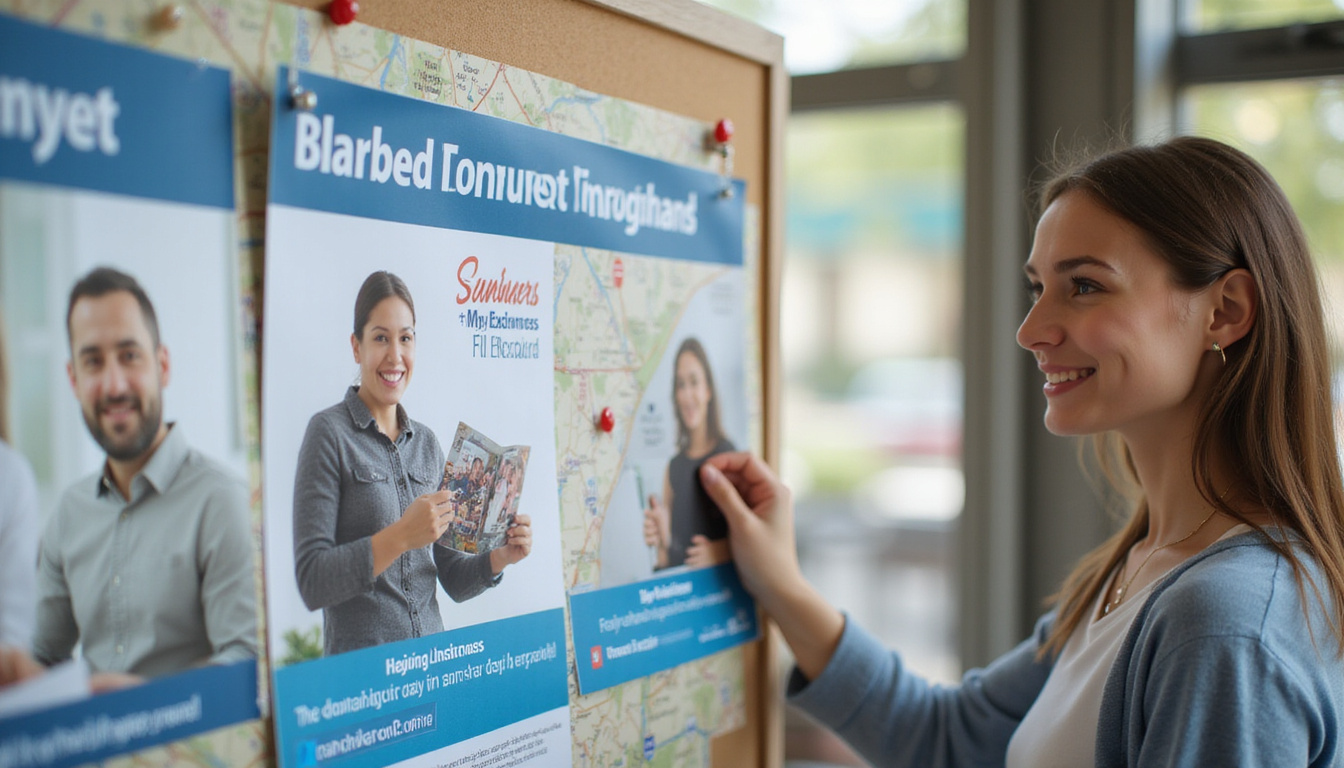
- Local bulletin boards (libraries, supermarkets, churches)
Best for: Businesses looking to enhance community presence and goodwill.
Tips:
- Tailor your messaging to the event’s theme or audience.
- Have a simple giveaway or contest that requires keeping the printed piece.
- Include a compelling reason to visit your location within a specific timeframe.
Make your print pieces impossible to ignore
Good distribution won’t save a weak design. To maximize your return, focus on clarity, benefits, and action.
Key elements of effective print design
- Clear hierarchy: One main message or offer stands out instantly.
- Strong headline: Highlight the benefit (“Save 20% on your first cleaning”) instead of just your business name.
- High-quality visuals: Use sharp images or graphics that reflect your brand and audience.
- Simple, scannable layout: Short text, bullet points, and plenty of white space.
- Bold call to action: Tell people exactly what to do and by when.
Include the right information
At minimum, every piece used in print distribution should have:
- Business name and logo
- Address (or service area)
- Phone number, website, and key social profiles
- Business hours (if relevant)
- A specific offer, reason to visit, or next step
- Expiration date or limited-time framing to encourage action
Integrate print distribution with your digital marketing
Print works best when it connects seamlessly to your online presence. This makes campaigns easier to track and amplifies your message across channels.
Use unique tracking tools
Incorporate:
- Custom promo codes: Example: “Use code LOCAL15 in-store or online.”
- Dedicated landing pages: Simple URLs like yoursite.com/neighbors.
- QR codes: Link to menus, booking pages, reviews, or sign-up forms.
- Unique phone numbers: Track calls generated by a specific campaign.
These tools allow you to see which print distribution tactics are working and where to invest more.
Encourage online engagement
On your printed materials, invite people to:
- Leave a review on Google or Yelp in exchange for a small incentive.
- Follow your social media profiles for exclusive deals.
- Sign up for your email list or SMS alerts via a short link or QR code.
This turns one-time offline interactions into ongoing digital relationships.
Plan your print distribution calendar and budget
Consistency beats one-off efforts. Treat print distribution as part of your ongoing marketing, not just something you do during a slow month.
Build a simple campaign calendar
Consider mapping out:
- Monthly or quarterly direct mail drops
- Seasonal door-to-door flyer campaigns
- Regular in-store handouts for loyalty or referral programs
- Event-based handouts timed with community activities
Align campaigns with:
- Local holidays and events
- Seasonal demand for your products or services
- Key business milestones (anniversaries, expansions, new offerings)
Allocate a realistic budget
Include:
- Design costs (professional or in-house)
- Printing costs (quantity, paper type, size)
- Distribution costs (postage, door-to-door teams, agency support)
- Tracking tools (unique numbers, landing pages, QR code generation)
Test small first, then scale up campaigns that show a clear return.
Measure and improve your print distribution ROI
Without measurement, you’re guessing. Simple tracking methods can reveal which approaches are profitable.
Track responses and conversions
Monitor:
- Number of calls or visits from each code/offer
- Coupon redemptions by neighborhood or channel
- Landing page visits tied to print URLs or QR codes
- Revenue generated from specific campaigns
Compare these results to your campaign costs to estimate return on investment.
Refine based on data
Use your findings to:
- Double down on the neighborhoods or partner locations that perform best
- Drop underperforming designs or offers
- Adjust your frequency and timing
- A/B test different headlines, images, or offers on similar distribution routes
Over time, your print distribution will become more efficient and predictable.
Example: A simple local print distribution plan
To illustrate, here’s how a neighborhood pizzeria might structure their efforts:
- Door-to-door flyers: Distribute 3,000 flyers within a 1.5-mile radius, featuring a “Buy 1 Get 1 Half Off” offer with code PIZZA10.
- EDDM postcards: Send 2,000 postcards to local households promoting a weekday lunch special with a QR code to the online menu.
- In-store coupons: Include “10% off your next order” cards with every dine-in and takeout receipt.
- Partner distribution: Place menu flyers at nearby offices and apartment building lobbies (with permission).
- Measurement: Track redemptions of PIZZA10, QR scans, and coupon returns over 60 days to evaluate which channels generated the most revenue.
This modest, structured approach can significantly lift orders and customer frequency over time.
FAQ: Print distribution for local businesses
Q1: How effective is print distribution for small local businesses?
When targeted correctly, print distribution can be very effective for local businesses. It reaches people in specific neighborhoods, builds trust through tangible materials, and often delivers higher engagement than some digital ads—particularly for local services and storefronts.
Q2: What’s the best type of print distribution for a service-based business?
Service providers often see strong results from a mix of direct mail and door-to-door print distribution, especially using door hangers or postcards with clear, time-bound offers. Partnering with complementary local businesses to display brochures or flyers can further expand reach.
Q3: How can I track results from my print distribution campaigns?
Use unique promo codes, QR codes, dedicated landing page URLs, or campaign-specific phone numbers. Compare responses and sales tied to each code or channel, then adjust your future print distribution efforts based on what performs best.
Turn local attention into lasting customer relationships
Well-planned print distribution doesn’t just scatter paper—it strategically places your message into the hands and homes of people most likely to buy from you. By targeting the right neighborhoods, using compelling designs and offers, and integrating print with your digital channels, you can significantly boost both visibility and sales.
If you’re ready to turn your local presence into a real competitive advantage, start mapping your first print distribution campaign now. Define your best local customers, choose two or three distribution channels from this guide, and commit to testing for the next 60–90 days. With each cycle, you’ll refine what works—and watch your local business grow as a result.