
For many small businesses, flyer design is one of the most cost-effective ways to grab attention, drive foot traffic, and promote offers. Yet most flyers end up in the trash within seconds, not because print marketing doesn’t work, but because the design doesn’t. When you understand a few key secrets behind high-performing flyers—how they look, what they say, and how they’re distributed—you turn a simple piece of paper into a powerful marketing tool.
Below are practical, proven strategies you can apply even if you’re not a designer and you’re working with a tight budget.
1. Start With One Clear Objective
The biggest mistake in flyer design is trying to do everything at once. Before choosing colors or fonts, define a single goal.
Common objectives for small business flyers:
- Promote a specific sale or event
- Generate leads (email sign-ups, free consultations)
- Increase foot traffic to your store
- Build awareness for a new product or service
Ask yourself:
- What is the one action I want someone to take after seeing this flyer?
- How will I measure success (calls, visits, coupon redemptions, QR code scans)?
When you pick one objective, every design choice becomes easier and more focused.
2. Use the AIDA Framework to Structure Your Flyer
Great flyer design is less about decoration and more about guiding the reader’s eye and emotions. The classic AIDA formula works extremely well:
A – Attention
Grab attention from a distance with:
- A bold headline
- A high-impact image
- Strong color contrast
I – Interest
Use a subheading or short intro to explain what you’re offering and why it matters.
D – Desire
Add benefits, social proof, or an irresistible offer:
- “Save 30% this weekend only”
- “Trusted by 500+ local customers”
A – Action
End with a clear, specific call to action (CTA):
- “Call now to book: 555-123-4567”
- “Bring this flyer for a free dessert”
- “Scan the QR code to claim your offer”
Design your layout so the reader can follow this flow in a few seconds.
3. Craft Headlines That Earn a Second Look
Your headline is the most important text element in your flyer design. If it doesn’t hook people, they won’t read further.
Tips for compelling flyer headlines
-
Lead with the benefit, not your business name.
Instead of “Smith Fitness Center,” try “Get Fit in 30 Minutes a Day.” -
Be specific.
“Free Tax Consultation for Local Business Owners” is stronger than “Tax Help Available.” -
Use action verbs.
“Discover,” “Save,” “Learn,” “Transform,” “Join” are simple but powerful. -
Make it readable from 6–10 feet away.
Use large font size, strong contrast, and keep it under 10–12 words if possible.
Remember: Your logo supports your message, but it should rarely be the headline.
4. Design for the “3-Second Glance”
Most people will assess your flyer in about three seconds. Effective flyer design passes the “glance test”: someone can quickly see what, who, and how.
Ask yourself:
- Can someone understand what this flyer is about in 3 seconds?
- Can they find the main benefit in 5 seconds?
- Is the call to action obvious in 7 seconds?
To pass this test:
- Use large, simple headlines.
- Avoid walls of text. Aim for short phrases and bullet points.
- Make your CTA visually distinct (buttons, boxes, or contrasting color).
If it feels “too simple” to you, it’s probably just right for a passerby.
5. Choose Colors and Fonts That Support Your Message
Good flyer design isn’t about using every color and font available. It’s about consistency, contrast, and clarity.
Color choices
- Stick to 2–3 main colors: typically one primary, one secondary, and one accent.
- Use your brand colors where possible so your flyers align with your other marketing.
- Ensure strong contrast between text and background (e.g., dark text on light background).
Color psychology can reinforce your message (e.g., green for eco or finance, red for urgency, blue for trust), but readability always comes first.
Font choices
- Use no more than two font families (e.g., one for headings, one for body text).
- Choose clean, legible fonts (sans-serif fonts like Montserrat, Open Sans, or Lato work well).
- Maintain hierarchy:
- Headline: largest
- Subheadline: medium
- Body and details: smaller, but still clear
Print your flyer at actual size on a regular printer to check if everything is easy to read.
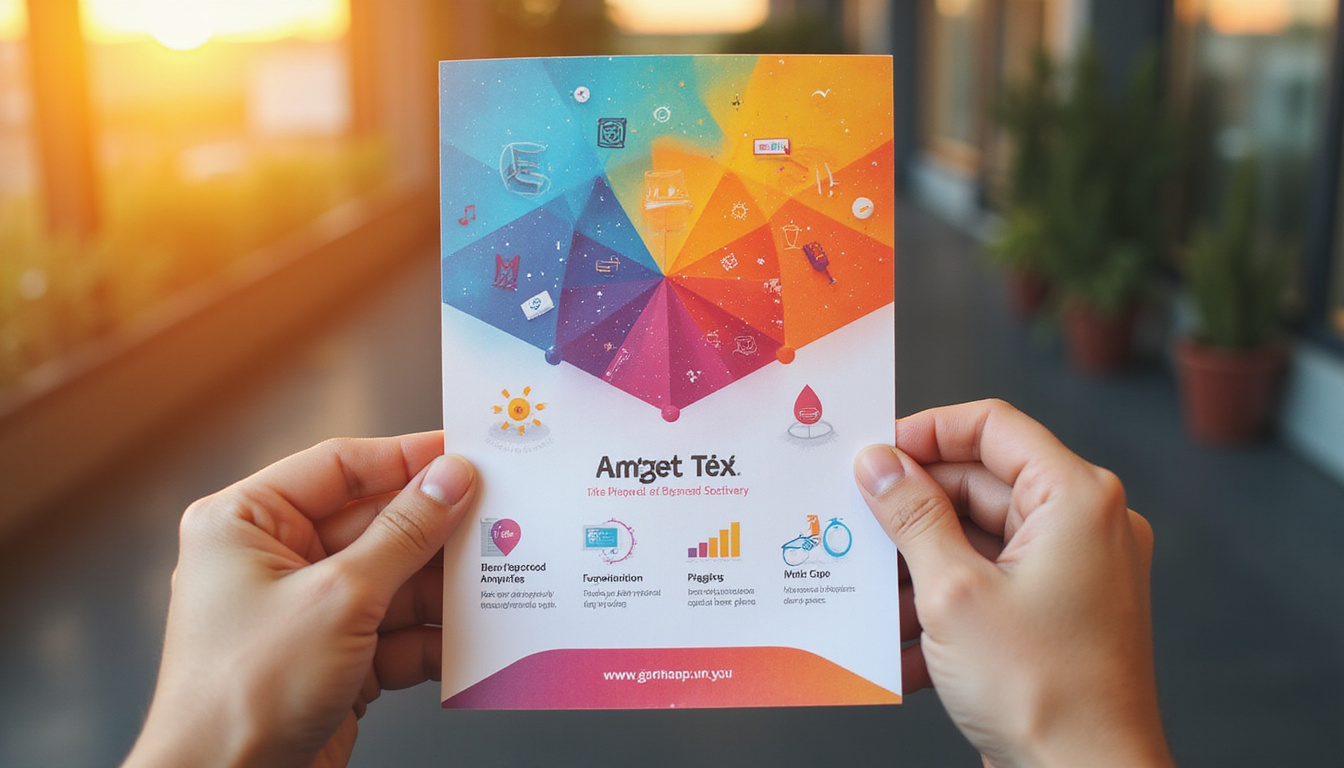
6. Use Images Strategically (and Legally)
Images can instantly convey emotion, quality, and context, but only if chosen carefully.
What makes a good flyer image?
- Relevant to your offer: show your product, happy customers, or the experience you provide.
- High resolution (at least 300 dpi) for sharp printing.
- Authentic: real photos from your business often outperform generic stock images.
If you use stock photos, choose from reputable sites and respect licensing rules (source: U.S. Copyright Office). Poor-quality or misused images can damage credibility or even create legal issues.
Place your main image so it supports—not competes with—your headline and CTA.
7. Keep Your Copy Short, Clear, and Benefit-Driven
On a flyer, every word has to earn its place. People are skimming, not studying.
Keep text scannable
- Break information into short sections with subheadings.
- Use bullet points for features and benefits.
- Avoid jargon; write like you talk to a customer face-to-face.
Focus on benefits, not just features
Instead of:
- “We offer high-speed internet and advanced routers.”
Try:
- “Stream, game, and work from home without buffering or dropouts.”
Translate what you do into why it matters to your ideal customer.
8. Make Your Call to Action Impossible to Miss
The best-designed flyer fails if people don’t know what to do next. Your CTA should be:
- Crystal clear: “Call to book,” “Visit us today,” “Order online.”
- Visually highlighted: use a button shape, border, or color block.
- Low friction: make the action easy to take.
Include:
- Phone number (formatted clearly, big enough to read)
- Website or landing page (short and memorable)
- QR code (optional, but very effective to bridge print and digital)
- Physical address and business hours, if relevant
Limit it to one primary CTA; secondary options can appear smaller (e.g., website in the footer).
9. Use Offers and Incentives That Drive Response
Adding a compelling offer can dramatically increase flyer response rates.
Examples that work well:
- Limited-time discounts (“20% off this weekend only”)
- Free add-ons (“Free drink with any lunch order”)
- Free consultations or trials
- “Bring this flyer” bonuses (easy way to track performance)
To make offers more effective:
- Add an expiry date to create urgency.
- Make redemption simple (show flyer, scan code, or use short code).
- Specify any key conditions clearly but briefly.
10. Design for Print From the Start
Even if you design your flyer on a computer, it must be optimized for printing.
Key print considerations:
- Size: Common sizes are A5, A6, or US Letter/half-letter. Smaller sizes reduce cost and make distribution easier.
- Bleed and margins: If you want color to the edge, include printer bleed (usually 3mm / 0.125") and keep critical text inside safe margins.
- File format: Export as high-resolution PDF with fonts embedded.
- Paper choice: Heavier stock (e.g., 100–130 lb / 170–300 gsm) feels more premium and durable.
Ask your printer for a proof before committing to a large run.
11. Plan Your Distribution as Carefully as Your Design
Great flyer design only matters if the right people see it.
Consider:
- Location: Where does your ideal customer live, shop, commute, or wait around?
- Timing: Align distribution with your offer (weekend sale, event date, seasonal demand).
- Method:
- Door-to-door in specific neighborhoods
- In-store handouts or bag-stuffers
- Community boards, cafés, gyms, laundromats
- Partner locations (other local businesses serving a similar audience)
Track where you distribute and compare it with responses (coupon codes, “How did you hear about us?” questions).
12. Test, Measure, and Improve
Treat flyer design like any other marketing: something you refine over time.
Simple ways to track effectiveness:
- Unique discount codes printed on the flyer
- QR codes linked to a dedicated landing page
- Separate phone number or extension
- Asking new customers what brought them in
Test variations:
- Different headlines
- Different images
- Different offers
- Different neighborhoods or drop times
Keep what works; change what doesn’t. Over time, your flyers can become a reliable, predictable source of leads and sales.
FAQ: Common Questions About Effective Flyer Design
Q1: What makes a good flyer layout for a small business?
A good layout for small business flyer design follows a clear hierarchy: headline at the top, supporting image and benefit-focused copy in the middle, and a bold call to action at the bottom. Use enough white space so elements don’t feel cramped, and ensure the reader’s eye naturally flows from top to bottom or left to right.
Q2: How much text should I include in a business promotion flyer?
Aim to keep your promotional flyer design concise: a headline, a short subheading, 3–6 bullet points for key benefits, and a brief offer description. If you’re filling more than half the page with dense text, you likely need to trim and simplify. Let visuals and clear formatting do part of the communication work.
Q3: Do digital tools really help non-designers create professional flyers?
Yes. Many online flyer maker and graphic design tools offer templates designed by professionals. If you choose a template, customize it with your brand colors, fonts, and images, and then apply the principles above—clear hierarchy, strong CTA, focused message—to turn a generic template into an effective, brand-aligned flyer.
Powerful flyer design doesn’t require a big budget or advanced design skills; it requires clarity, focus, and a willingness to test and improve. Start with one specific objective, craft a strong headline and offer, and build a clean layout around your call to action. If you’re ready to turn your flyers from “nice to have” into a consistent source of customers, choose one upcoming promotion today, apply these secrets, and get your first batch printed and out in the world. Your next loyal customers may only be one flyer away.