
Yard Signs That Convert Drive-Bys Into Sales: Design and Placement Tips
If you rely on local traffic for leads, yard signs can be one of the most cost-effective marketing tools you’ll ever use. Done well, yard signs don’t just decorate a lawn—they stop cars, grab attention, and turn drive-bys into phone calls, website visits, and sales. In this guide, you’ll learn exactly how to design and place yard signs so they actually convert, not just blend into the background.
Why Yard Signs Still Work in a Digital World
Even in an online-first era, yard signs are powerful because they:
- Put your message directly in front of nearby, high-intent prospects
- Build local brand recognition through repetition
- Create social proof (“If my neighbor uses them, they must be good”)
- Are inexpensive and reusable compared with many other ad channels
According to the International Sign Association, signs function as a “silent salesperson” that works 24/7 to attract customers and reinforce brand awareness (source). For local services—contractors, landscapers, real estate agents, political campaigns, home services, local events—yard signs can outperform more expensive media when optimized for visibility and clarity.
The Core Goal: One Message, One Action
The biggest mistake people make with yard signs is trying to say too much. Your real goal is simple:
Get a distracted driver or passerby to understand one message and take one action.
To achieve that, every sign should answer three questions at a glance:
- Who is this for? (Target audience or context)
- What is offered? (Service, event, sale, listing, etc.)
- What should I do next? (Call, text, visit, scan, turn here)
If your design doesn’t make those three things obvious in 2–3 seconds, it’s time to simplify.
Design Principles for High-Converting Yard Signs
1. Prioritize Readability Over Everything
If people can’t read it fast, it can’t convert.
- Font size: As a rule of thumb, use at least 1 inch of letter height for every 10 feet of viewing distance.
- 3–4" letters: sidewalks / close-up viewing
- 5–7" letters: typical neighborhood street traffic
- 8–12" letters: busy roads / higher speeds
- Font choice: Use clean, bold sans-serif fonts (e.g., Arial, Helvetica, Montserrat). Avoid scripts, thin fonts, or overly decorative typefaces.
- Line spacing: Keep enough space between lines so text doesn’t blur together from a distance.
Your headline (the main offer or message) should be the largest text on the sign. Contact info comes second.
2. Use High-Contrast Color Combinations
High contrast improves legibility at speed and distance. Some proven pairings:
- Black text on yellow
- Dark blue text on white
- White text on dark blue, black, or red
- Black text on light orange or lime green
Avoid:
- Light colors on light backgrounds
- Red text on blue background (or vice versa)
- Busy, photo-heavy backgrounds under your text
Limit your palette to 2–3 main colors: a background, a primary text color, and an accent color.
3. Keep the Message Ultra-Simple
Most effective yard signs contain:
- A clear headline (what you offer)
- A single way to respond (phone, URL, QR code, or directional arrow)
- Optional: a logo and a short credibility booster
Aim for 7 words or fewer in your main message. Examples:
- “Roof Leaks? Free Inspections”
- “We Buy Houses – Cash Fast”
- “Lawn Care – Weekly Service”
Each additional element must earn its place. If it doesn’t directly help someone understand or respond, cut it.
4. Make the CTA Impossible to Miss
Your call-to-action (CTA) is what turns a sign into a lead generator. Strong CTAs are specific and action-oriented:
- “Call Now: 555-123-4567”
- “Text ‘QUOTE’ to 555-123-4567”
- “Book Online: SmithRoofing.com”
- “Scan for 20% Off” (with a QR code)
Tips:
- Use a short, memorable phone number whenever possible.
- Keep URLs short and easy to spell (use redirect/short links if needed).
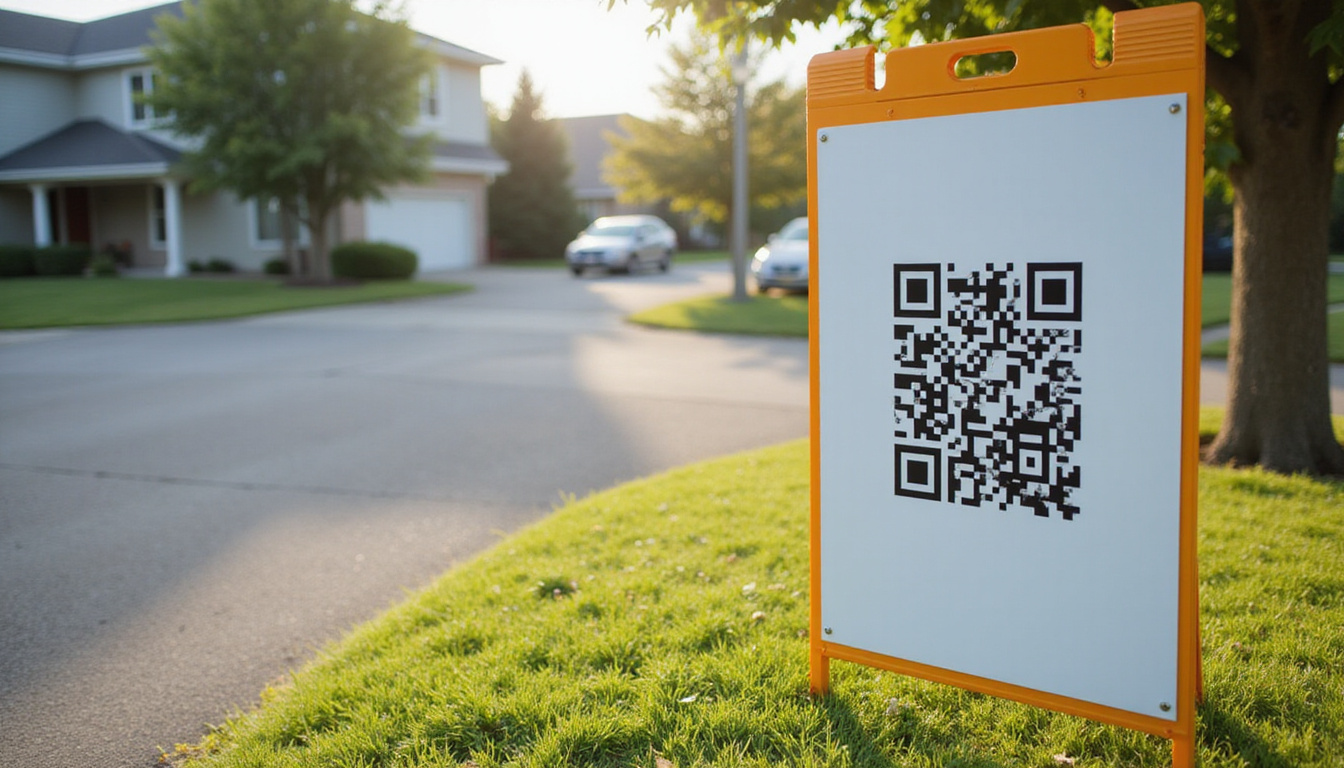
- If using a QR code, make it large and high-contrast; place it where passersby can safely stop or walk up to scan.
5. Brand for Recognition, Not Confusion
Your brand elements (logo, colors, tagline) should support your message, not compete with it.
- Place your logo smaller than the main message—think signature, not headline.
- Stick to your brand colors where possible, but not at the expense of contrast and readability.
- Use the same layout style across multiple signs to build recognition over time.
Optimizing Yard Sign Content for Different Goals
For Service Businesses (Contractors, Landscapers, Cleaners)
Focus on solving a visible or urgent problem:
- Highlight benefits: “Greener Lawns in 2 Weeks”
- Include a localized angle: “Serving Oak Hill & Nearby”
- Add proof: “Over 500 Local Homes Served”
Example layout:
- Top: “GUTTERS CLOGGED?”
- Middle: “Cleaned Today – Call 555-789-1234”
- Bottom: Logo + “Licensed & Insured”
For Real Estate Listings
You’re selling the property and your services at once:
- Use “FOR SALE,” “OPEN HOUSE,” or “JUST LISTED” prominently.
- Include your name or team name plus one contact method.
- Add directional riders (“Open House → Sunday 1–4 PM”).
Example:
- Top: “OPEN HOUSE” (large)
- Middle: “SAT 1–4 PM | 3BR, New Kitchen”
- Bottom: Agent name + phone + broker logo
For Events and Promotions
Emphasize timing and urgency:
- Must-include: event name, date, location, call to action.
- Use arrows generously for directions near the venue.
- Use urgency phrases: “One Day Only,” “This Weekend.”
Placement Strategy: Where Yard Signs Actually Get Noticed
The best design can fail if your placement is poor. Think like a driver: where do eyes naturally go?
1. Target High-Relevance Locations
Place yard signs where your ideal customers already are or have related needs:
- On lawns of current customers (with permission)
- At nearby intersections to your service areas
- Near complementary businesses (e.g., gyms for healthy meal prep)
- Along commute routes into residential neighborhoods
For real estate, contractor work, or home services, placing signs on active job sites builds live social proof: “Work in progress here.”
2. Consider Visibility from the Road
Key factors:
- Distance from the curb: 5–15 feet is typical, depending on local rules.
- Angle: Slightly angled toward approaching traffic, not parallel to the road.
- Height: Standard H-stakes (18–24" high) work for low grass; use taller frames if grass is high or if there are obstacles.
- Obstructions: Avoid trees, utility poles, tall shrubs, parked cars, and other signs that block sight lines.
3. Match Sign Density to Traffic Speed
The faster the speed, the fewer signs—and the more repetition—you should use:
- Low-speed residential (15–25 mph): Each sign can carry a bit more info.
- Main roads (30–45 mph): Keep text to the absolute essentials.
- Higher speeds: Use larger signs or multiple signs in sequence.
For example, along a 35–40 mph road, you might use three signs spaced out:
- “FREE ROOF INSPECTION”
- “CALL NOW”
- “555-123-4567”
Legal, Ethical, and Practical Considerations
Before blanketing an area with yard signs, check:
- Local sign ordinances: Many cities regulate sign size, placement, and duration.
- HOA rules: Homeowners associations may restrict signs in certain communities.
- Property owner permissions: Never place yard signs on private property without consent.
- Public right-of-way rules: Many areas don’t allow signs on medians or utility poles.
Beyond legality, be considerate. Avoid cluttering intersections or creating visual hazards that could distract drivers in dangerous ways.
Tracking and Improving Yard Sign Performance
To make yard signs a true marketing asset, you need to measure how well they work and refine over time.
1. Use Trackable Contact Methods
- Unique phone numbers (via call tracking services)
- Custom URLs or landing pages (e.g., YourBrand.com/roof)
- QR codes that lead to specific offer pages
This lets you connect calls or visits directly back to specific signs or locations.
2. A/B Test Small Changes
Test variations like:
- Different headlines (“Free Estimate” vs. “$0 Inspection”)
- Different color contrasts
- Phone number vs. website as the primary CTA
Run each version in similar locations and compare response rates over a set period.
3. Maintain and Refresh Signs
Faded, bent, or stained yard signs send the wrong message about your brand.
- Use durable materials (coroplast for short-term, aluminum for longer-term).
- Clean or replace damaged signs regularly.
- Refresh designs annually or when offers change.
Practical Yard Sign Checklist
Before you print or place your next batch of yard signs, run through this quick checklist:
- [ ] Main message is 7 words or fewer
- [ ] Font is bold, simple, and large enough
- [ ] High-contrast background and text colors
- [ ] Only one primary call to action
- [ ] Phone or URL is short and highly readable
- [ ] Logo is present but not overpowering
- [ ] Sign layout still works in black-and-white (contrast test)
- [ ] Design looks clear when viewed from 20–40 feet away
- [ ] Placement locations checked for visibility and legality
- [ ] A tracking method is in place (phone, URL, QR, or code word)
FAQ: Common Questions About Yard Signs
1. What size yard signs work best for business promotion?
For most local business yard signs, 18" x 24" is a popular and effective size: large enough to read from a typical street, but still affordable and easy to handle. For high-speed roads or important directional signage, consider stepping up to 24" x 36".
2. How many yard signs should I use in my area?
Instead of a random number, think in terms of coverage and repetition. Aim to place yard signs at key entry points to your service area, at active job sites, and along major neighborhood routes. Many small service businesses start with 25–50 signs, then add more in areas that generate calls.
3. How long should I leave yard signs out?
Duration depends on your campaign and local rules. For ongoing services (like lawn care or roofing), you might leave yard signs up near long-term customers for weeks or months if allowed. For events, remove them within 24–48 hours after the event. Always follow city and HOA regulations on how long signs can remain in place.
Turn Your Yard Signs Into Silent Salespeople
Yard signs are one of the few marketing tools that can work nonstop—day and night, in the exact neighborhoods you want to reach—without a monthly ad bill. When you combine smart design, strategic placement, and simple tracking, those small rectangles of coroplast or aluminum can become a steady source of leads and revenue.
If you’re ready to turn your yard signs into true sales assets instead of afterthoughts, start by auditing your current designs and placements using the checklist above. Then test one improved design in a few prime locations and measure the impact. Need help refining your message, layout, or placement strategy? Reach out today for a customized yard sign plan tailored to your business, so every drive-by becomes an opportunity for a new sale.