
Billboard Advertising Strategies That Skyrocket Local Business Visibility and Sales
Billboard advertising is one of the most powerful ways a local business can get in front of thousands of potential customers every single day. When done strategically, it can transform a brand from “never heard of it” to “I see them everywhere” in a matter of weeks—and that visibility often translates directly into more calls, visits, and sales.
This guide walks you through practical, proven billboard advertising strategies tailored for local businesses, so you don’t waste money on expensive signs that nobody remembers.
Why Billboard Advertising Still Works for Local Businesses
In an age of smartphones and social media, you might assume outdoor ads are outdated. The opposite is true.
- Drivers and commuters are a captive audience.
- People often take the same routes daily, leading to repeated exposure.
- Billboards can’t be “skipped,” blocked, or scrolled past.
- They create a sense of size, trust, and permanence.
According to the Out of Home Advertising Association of America (OAAA), 66% of smartphone users have taken an action on their device after seeing an out-of-home ad, such as searching for the advertiser or visiting their website (source). That’s a huge opportunity for local brands that want to drive both in-person and online engagement.
Step 1: Define a Clear, Measurable Goal
Before you design or book any billboard advertising, get specific about what you want it to achieve. “More business” is too vague.
Common local billboard goals include:
- Increasing foot traffic to a specific location
- Driving phone calls or appointment bookings
- Growing website visits or online orders
- Promoting a limited-time sale or event
- Building brand awareness in a new part of town
Tie your goal to a simple, trackable action. For example:
- “Increase calls from ZIP code 12345 by 20% in 3 months”
- “Get 300 new website visits from billboard traffic this month”
- “Sell out of our weekend event (150 ticket goal)”
When your objective is clear, every decision about placement, messaging, and design becomes easier and more effective.
Step 2: Choose Billboard Locations Strategically
For local businesses, location is everything. One great billboard in the right spot is more valuable than five in the wrong ones.
Focus on Your Real-World “Catchment Area”
Your catchment area is where most of your customers actually come from. Look at:
- Existing customer addresses or ZIP codes
- Delivery or service radius
- Areas with similar demographics to your best customers
Then prioritize billboard locations in those areas.
Look for High-Traffic, High-Relevance Spots
You’re not just buying eyeballs—you’re buying context.
Ideal billboard advertising locations for local businesses include:
- Major roads leading into your neighborhood or shopping district
- Near intersections with frequent stops or slow-moving traffic
- Close to competitors or complementary businesses
- Approaches to your store (e.g., “Next right,” “2 miles ahead”)
Ask your media rep for:
- Traffic counts (Average Daily Impressions or Average Daily Traffic)
- Viewing angle and visibility (obstructions, height, speed limit)
- Direction of travel (are drivers heading toward your business?)
Sometimes a slightly lower-traffic but better-placed billboard—e.g., directly on the route to your store—outperforms a busier highway board far away.
Step 3: Craft a Message That Works at 60 MPH
Billboard advertising has about 5–7 seconds to do its job. That means:
One big idea. One clear action. Almost nothing else.
Keep the Copy Short and Punchy
Aim for 7 words or fewer of main copy, plus:
- Your logo or business name
- One call to action (CTA)
- Optional: short URL, phone, or QR code
Examples:
- “Teeth hurt? Walk-in dentist, next exit.”
- “Tacos this good deserve a detour.”
- “Leaky roof? Call [BrandName] now.”
If drivers can’t understand your message in a single glance, it won’t work.
Make the CTA Ridiculously Simple
People are driving. Don’t expect them to remember a full sentence.
Good CTA options for billboards:
- “Exit 12 – Turn Right”
- “Call 555-1234”
- “Scan for 20% off”
- “Visit SmithAuto.com”
Use one primary action only. If you give people multiple choices (“call, visit, follow us, download our app”), they’re less likely to do any of them.
Step 4: Design for Distance, Not for Your Laptop Screen
A common mistake in billboard advertising is designing as if it’s a brochure. Billboards must communicate clearly from hundreds of feet away.
Design Principles That Boost Visibility
- Big fonts only: Sans-serif fonts, no script or cursive. Think large, bold, and legible.
- High contrast: Dark text on light background or vice versa (e.g., white text on blue).
- Strong hierarchy: One focal point — usually your main message or image.
- Limit elements: One image, one headline, one logo. That’s often enough.
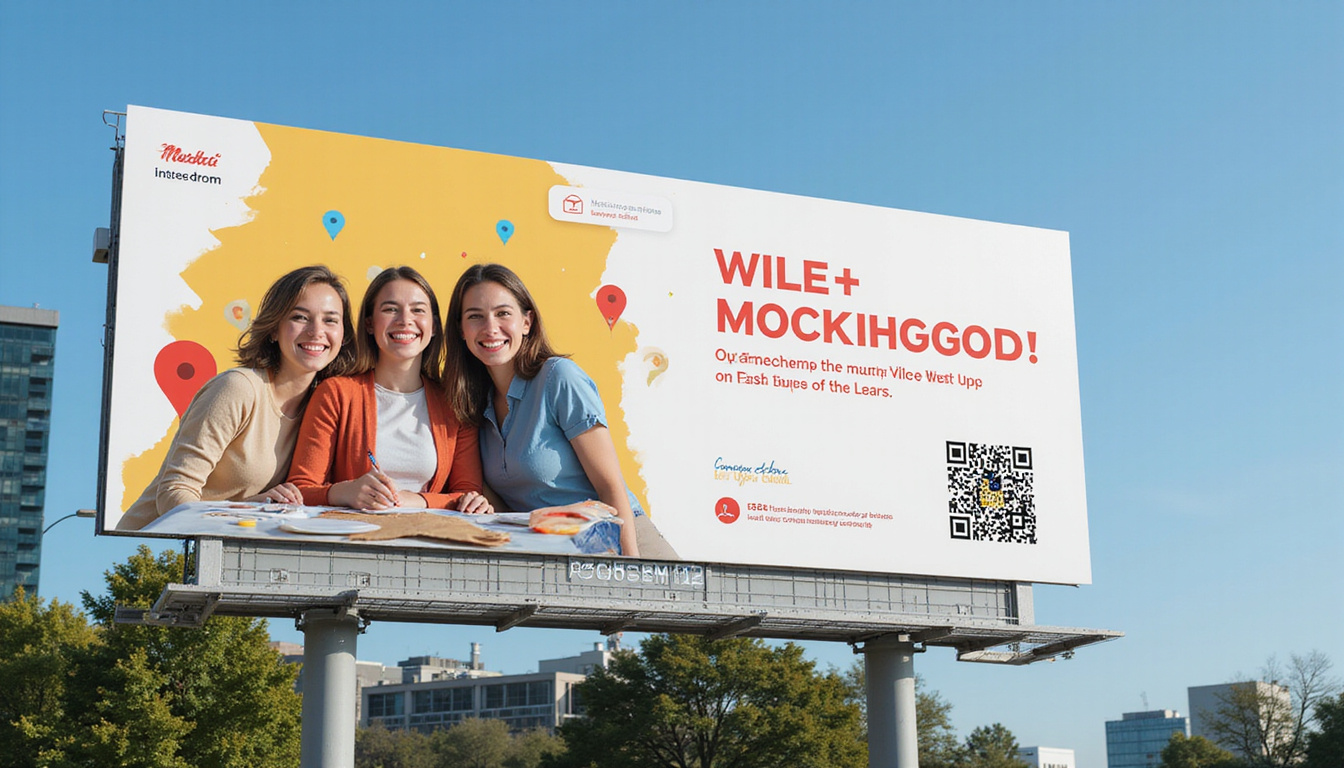
- Use faces when relevant: Human faces, especially eyes, grab attention quickly.
Brand Consistency Matters
Even though you have limited space, keep core brand elements consistent:
- Logo
- Brand colors
- Tone of voice (“fun,” “professional,” “luxury,” etc.)
The goal is that when someone sees your social ads, website, or storefront, they instantly recognize you as “that business from the billboard.”
Step 5: Use Offers and Urgency to Drive Action
Visibility alone doesn’t guarantee sales. Tie your billboard advertising to specific offers that give people a reason to act now.
Smart Offer Ideas for Local Businesses
- “Show this ad for 10% off” (with a simple promo code like “DRIVE10”)
- “Free dessert with any entrée – This Week Only”
- “First visit free” or “$0 consultation”
- “Grand Opening: 25% off all services this month”
Add a clear timeline if possible: “Ends Sunday,” “This Month,” “Limited Time.”
Urgency taps into commuters’ routine: they may pass your sign every day, but a time-bound offer nudges them to actually stop.
Step 6: Integrate Billboards With Your Online Marketing
Often, the biggest returns from billboard advertising come when it’s part of a broader marketing system, not a standalone stunt.
Make It Easy to Continue the Journey Online
- Use a short, memorable URL (e.g., BrandCity.com or TryBrand.com).
- Create a dedicated landing page matching the billboard design and message.
- Use a simple QR code (large and high-contrast) for urban or slow-traffic locations.
- Add a promo code that’s unique to the billboard campaign.
When people scan or visit, they should see the same headline, colors, and offer they saw on the billboard. This builds trust and reduces friction.
Retarget Billboard Viewers Digitally
You can’t know who saw the billboard, but you can:
- Run social ads targeted to the same ZIP codes and commute corridors.
- Use geofencing to serve mobile ads to people who travel through certain areas.
- Sync your Google Ads copy and visuals with the billboard campaign.
When people encounter your brand repeatedly—on the road, on their phone, and near your store—they’re far more likely to remember and choose you.
Step 7: Measure the ROI of Your Billboard Campaign
Billboard advertising may feel “old school,” but you can still track results and optimize.
Ways to Track Performance
Use one or more of these methods:
-
Unique phone number
- Use a tracking number that forwards to your main line.
- Monitor calls and ask “How did you hear about us?” to validate.
-
Billboard-specific URL or landing page
- Example: SmithDental.com/Highway
- Check traffic and conversions on that page.
-
Promo codes
- Use a code only shown on your billboard (e.g., “HIGHWAY20”).
- Track redemptions in your POS or booking system.
-
Ask at the point of sale
- Train staff to ask, “What brought you in today?” and log “Billboard” responses.
Compare results across:
- Different locations
- Different messages or offers
- Seasonal variations (summer vs. winter traffic patterns)
Then re-invest more heavily in the combinations that deliver the best balance of cost and impact.
Step 8: Tailor Your Billboard Strategy to Your Type of Business
Certain businesses benefit from specific billboard advertising approaches. Customize based on what you sell.
For Restaurants, Cafés, and QSR
- Use hunger-inducing visuals and simple directions (“Exit 7 – 2 min ahead”).
- Promote daily specials or drive-thru convenience.
- Place billboards just before a decision point (e.g., near exits and intersections).
For Home Services (Plumbers, Roofers, HVAC, etc.)
- Focus on reliability and speed (“24/7 emergency service – Call 555-1234”).
- Emphasize local trust (“Serving [City] for 20+ years”).
- Use memorable taglines or mascots that stick in people’s minds.
For Health, Beauty, and Wellness
- Showcase positive outcomes (bright smiles, clear skin, before/after).
- Highlight risk-free or introductory offers (“First session free”).
- Use credible, comforting language and imagery.
For Auto Dealers and Repair Shops
- Promote easy financing, warranties, or fast service.
- Use directional cues if you’re near highways (“On your left in 0.5 miles”).
- Feature recognizable local landmarks in the background for relevance.
Common Billboard Advertising Mistakes to Avoid
Steer clear of these frequent pitfalls that waste budget:
- Too much text: If you need more than 5–7 seconds to read it, it’s not a billboard, it’s a wall of text.
- Tiny or cluttered visuals: Drivers can’t decipher complex charts, maps, or tiny product shots.
- Weak or missing CTA: “Brand awareness” is rarely enough for a local business; give people something to do.
- Ignoring placement context: Promoting “downtown parking” on a highway leading out of town, for example.
- Inconsistent branding: Billboard looks nothing like your storefront, website, or social media.
A simple, bold, well-placed billboard will nearly always outperform a complicated, clever one.
Quick Checklist for Winning Local Billboard Campaigns
Use this list to stress-test your billboard advertising plan:
- [ ] One clear, measurable campaign goal
- [ ] Locations mapped to your real customer catchment area
- [ ] Short, bold headline (7 words or fewer)
- [ ] Single, simple CTA (call / visit / exit / scan)
- [ ] Highly legible fonts and strong color contrast
- [ ] Offer or reason to act now, if appropriate
- [ ] Consistent branding with your online and offline presence
- [ ] Tracking method (phone, URL, promo code, or survey)
- [ ] Plan to compare performance and optimize next buy
If you can’t check most of these, refine before you launch.
FAQ: Billboard Advertising for Local Businesses
1. Is billboard advertising effective for small local businesses, or only big brands?
Billboard advertising can be extremely effective for small, local businesses when it’s targeted to the right areas and tied to a clear offer or action. Big brands use billboards for mass awareness, but local companies often see direct results in calls, visits, and sales by focusing on strategic placement and simple, relevant messaging.
2. How much does local billboard advertising typically cost?
Costs vary widely depending on city size, location, and whether the board is static or digital. In smaller markets, a traditional billboard might range from a few hundred to a couple thousand dollars per month; in larger or high-traffic urban areas, prime boards can cost significantly more. The key is to compare cost per impression and the revenue you generate from tracked calls, visits, or redemptions.
3. What’s better for a local business: digital billboards or traditional billboard advertising?
Both can work. Traditional billboards are usually cheaper and give you 100% share of the display. Digital billboards often cost more per impression but allow for flexible scheduling, rotating creative, time-of-day messages, and quick changes for promotions or weather-based offers. The best choice depends on your budget, how often you need to update your message, and the available locations in your area.
Turn Passing Traffic Into Paying Customers
Every day, thousands of potential customers drive past your neighborhood, thinking about what to eat, where to shop, and who to hire. Smart billboard advertising puts your business into that decision-making moment with a message they can’t ignore.
If you’re ready to turn anonymous traffic into loyal customers, start planning your first (or next) billboard campaign with a clear goal, a sharp message, and a way to measure results. Talk to local outdoor media providers, map your best locations, and design a bold, simple board that truly represents your brand.
Your future customers are already driving by. It’s time to give them a reason to stop for you instead of your competitors.