
Hang tags are more than small pieces of cardboard dangling from your products—they’re mini billboards that travel in your customer’s hand. When used strategically, hang tags can boost perceived value, communicate your brand story, and even increase average order value. With smart label design, you can turn ordinary hang tags into powerful sales tools that work quietly but effectively at the point of decision.
Even in an era of smartphones and social media, physical touchpoints are crucial. Customers still pick up items, feel the fabric or material, and flip the hang tag to decide whether to buy.
Strategically designed hang tags can:
- Reinforce brand positioning (luxury, eco-friendly, minimalist, playful, etc.)
- Explain product benefits and justify higher prices
- Direct customers to your website or social channels
- Encourage add-on purchases or bundles
- Reduce returns by clarifying care instructions and fit
Research shows that clear packaging and labeling can increase purchase intent by up to 20–30% in some categories (source: Nielsen packaging research). Hang tags are part of that critical visual and informational ecosystem.
Step 1: Define the goal of your hang tag
Before you think about fonts or colors, decide what you want your hang tags to do. A tag trying to do everything usually ends up doing nothing well.
Common hang tag goals include:
- Drive immediate purchase – Highlight value, discounts, or key differentiators.
- Educate – Explain materials, craftsmanship, or technology (e.g., waterproof, UV-protected, organic).
- Build brand affinity – Tell a short brand story or mission.
- Capture digital engagement – Push shoppers to a QR code, social handle, or landing page.
- Upsell or cross-sell – Suggest matching items or bundles.
Pick one primary goal and one secondary at most. This clarity will guide every design choice.
Step 2: Craft a message that sells, not just describes
Many hang tags waste valuable space on generic information. Instead, write like a salesperson standing right next to your customer.
Focus on:
-
A strong hook line
One short sentence that sums up the main benefit. Examples:- “Warmth without the bulk.”
- “Looks like leather, feels like freedom.”
- “Designed to last 5x longer than basics.”
-
Benefit-first copy
Don’t just list features like “100% cotton” or “Stainless steel buckle.” Turn them into benefits:- “100% organic cotton for breathable, all-day comfort.”
- “Stainless steel buckle that won’t rust, chip, or fade.”
-
Social proof or credibility
If space allows, add:- “Trusted by 20,000+ runners”
- “Family-owned since 1984”
- “Backed by a 2-year warranty”
-
A clear call to action (CTA)
Give the customer one next step:- “Scan for styling tips & care guide”
- “See how it’s made → yourbrand.com/story”
- “Share your look: #YourBrandStyle”
Write your hang tag copy out first in a document, then trim. Every word must earn its place.
Smart label design balances aesthetics with readability. Beautiful tags that are hard to read won’t help you sell more.
Choose fonts with purpose
Use no more than two typefaces:
- Primary font for brand and headings – should reflect your personality (e.g., elegant serif for luxury, clean sans-serif for modern).
- Secondary font for body text – highly legible at small sizes.
Avoid fonts that are too thin, overly ornate, or compressed, especially if your hang tags are small. Always print samples at actual size before approving a design.
Use color to signal value and mood
Color influences perception instantly:
- Luxury / premium: Black, deep navy, forest green, rich burgundy, with metallic foils.
- Eco / natural: Kraft brown, olive, muted greens, off-whites.
- Sporty / energetic: Bright accents (red, orange, neon) on neutral bases.
- Minimal / modern: Whites, greys, and a single accent color.
Ensure strong contrast between text and background for readability. If using brand colors that are light or pastel, consider a darker tag background or block out text areas.
Step 4: Use structure and layout to guide the eye
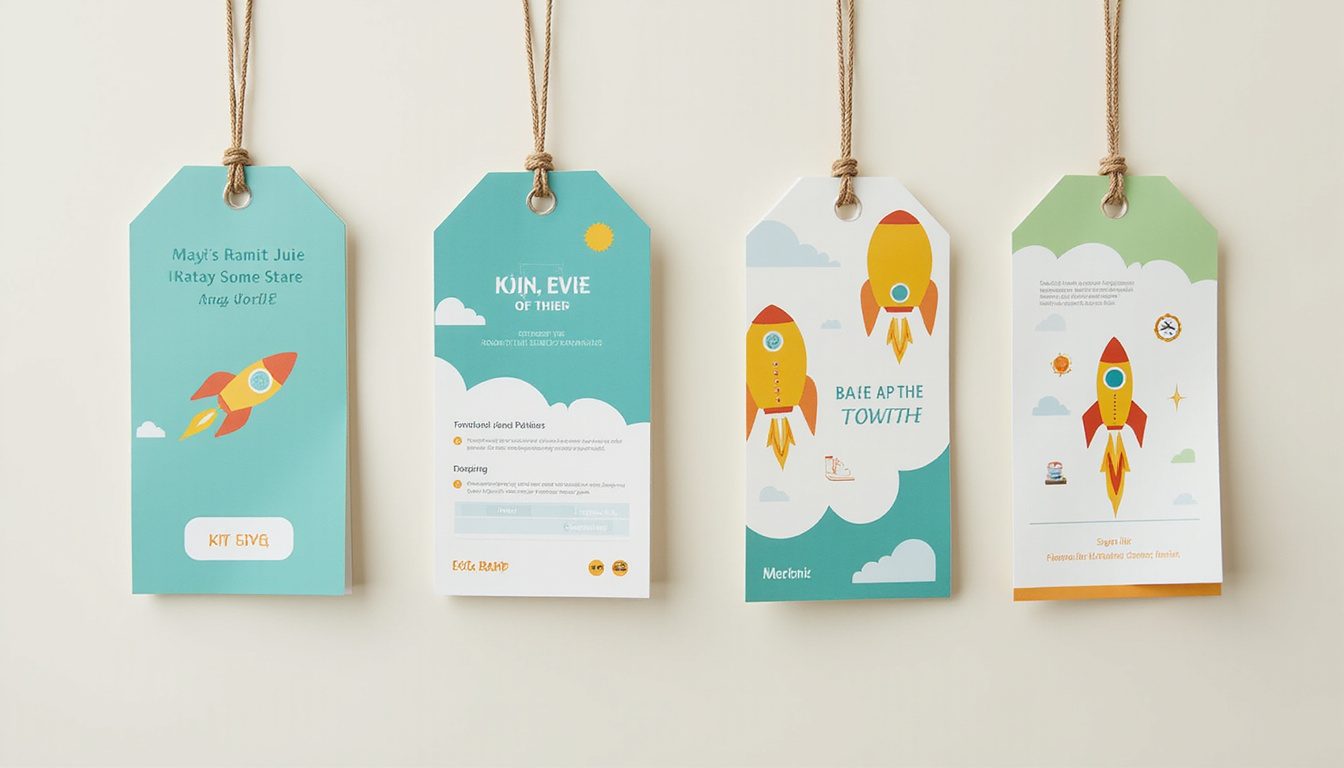
Think of your hang tag as a tiny landing page. There’s a visual hierarchy:
-
Front of the hang tag
- Brand name or logo
- Short tagline or product line name
- Possibly a key descriptor (e.g., “Waterproof Jacket”)
-
Back of the hang tag
- Hook line or benefit statement
- Short bullet list of key benefits
- QR code or URL
- Care icons or essential details
Use whitespace. Cramming too much information onto hang tags makes them look cheap and overwhelming. A clean, breathable layout suggests confidence and quality.
Step 5: Add elements that directly drive conversions
Small design choices can have an outsized effect on whether someone buys. Consider integrating:
- Limited-time or scarcity cues
- “Limited run: 500 pieces”
- “Small-batch, hand-finished”
- Guarantee messaging
- “Love it or return it within 30 days”
- “Lifetime repair guarantee”
- Price justification
Especially for higher-priced items:- “Handmade by artisans in Portugal”
- “Made with GOTS-certified organic cotton”
- Bundling suggestions
- “Pairs perfectly with our Classic Jogger”
- “Complete the set with the matching necklace”
These cues turn hang tags into persuasive tools, not just identifiers.
Step 6: Material and finishing choices that signal quality
The moment someone touches your hang tags, they unconsciously judge your brand. Materials and finishes should align with your positioning and pricing.
Materials
- Standard coated card stock – Good for most fashion and retail products.
- Uncoated / textured stock – Feels more organic and premium, ideal for artisan or sustainable brands.
- Kraft or recycled stock – Strong eco signal; suits eco-conscious or rustic aesthetics.
- Specialty materials (wood veneer, fabric, leatherette) – Best for high-end or niche products.
Finishes and effects
Use finishes sparingly but intentionally:
- Foil stamping – Gold, silver, rose gold, or colored foils for logos or key text.
- Embossing / debossing – Creates tactile, raised or recessed details.
- Spot UV – Glossy highlight on matte stock for logos or patterns.
- Die-cut shapes – Custom silhouettes (e.g., product outline, logo shape) for memorability.
- Rounded corners / unique hole placements – Subtle differences that feel considered.
If your product is marketed as sustainable, ensure finishes and coatings are compatible with recycling or composting claims.
The most effective hang tags bridge in-store moments with longer customer relationships.
Ways to connect the dots:
-
QR codes
Link to:- Product care videos
- Behind-the-scenes manufacturing stories
- In-depth product specs and size guides
- Style inspiration galleries
-
Social media handles and hashtags
Make them specific:- “Tag us @YourBrand and use #YourBrandCrew to get featured”
-
Trackable URLs or UTM links
Use short, memorable URLs and campaign tags to measure performance of specific hang tag variations. -
Exclusive perks
Offer something that only hang tag holders see:- “Scan this tag for 10% off your next order”
- “Members-only styling guide inside”
This turns a one-time purchase into an ongoing conversation.
One generic hang tag for your entire catalog is a missed opportunity. Tailor content and design to key product lines.
By product type
- Apparel: Focus on fit, fabric, care, and styling ideas.
- Outdoor gear: Highlight durability, performance metrics, and warranty.
- Jewelry & accessories: Emphasize craftsmanship, materials (e.g., hypoallergenic, solid vs. plated), and gifting language.
- Home goods: Focus on materials, sustainability, and how the item improves daily life.
By audience segment
- Value-conscious shoppers: Emphasize durability, cost-per-wear, and clear pricing benefits.
- Eco-conscious buyers: Prioritize sustainability credentials, certifications, and repairability.
- Luxury buyers: Highlight artisanship, exclusivity, and heritage.
A practical approach is to create a core brand hang tag template, then modify copy panels and accent colors for each product category.
Step 9: Test, measure, and iterate your hang tag design
Don’t treat hang tags as a one-and-done project. Small changes can lead to measurable lifts in sales.
Simple testing ideas:
-
A/B test messaging
- Version A: Emphasizes comfort
- Version B: Emphasizes durability
Track which products sell faster or have fewer returns.
-
Test QR destinations
See if scanning to a style guide vs. a discount page changes repeat purchase rates. -
Retail staff feedback
Ask sales associates:- “Which customer questions do our hang tags already answer?”
- “Where are people still confused?”
-
Customer surveys
Add a short, incentivized survey on the landing page your tags link to. Ask what information they found useful.
Use these insights to refine future print runs and gradually build hang tags that are not only on-brand but demonstrably effective.
Use this quick list before sending your design to print:
- Clear primary goal for the tag (sell, educate, drive online engagement, etc.)
- Strong, benefit-focused headline or hook
- Concise copy that converts features into benefits
- Visual hierarchy: logo → hook → benefits → CTA
- Legible fonts and high-contrast colors
- Material and finishes that match brand positioning
- QR code or URL tested and working
- Social proof, guarantees, or scarcity (where appropriate)
- Sustainability claims accurate and substantiated
- Space to breathe—no overcrowded text or visuals
1. What information should be on product hang tags to increase sales?
Focus on what helps a customer decide quickly: a clear product name, key benefits, material or quality indicators, sizing or fit notes (if relevant), and a simple call to action. Avoid cramming everything; your hang tags work best when they highlight just enough information to build confidence and curiosity.
2. How can custom hang tags support my brand story?
Use custom hang tags to share a short, emotionally resonant story: why you started, what you stand for, or how your product is uniquely made. Align paper choice, colors, typography, and finishes with this story so the tag feels like your brand the moment someone touches it.
3. Are eco-friendly hang tags worth the investment?
If your customers care about sustainability—or if your products are marketed as eco-conscious—then eco-friendly hang tags can reduce friction at purchase. Recycled or FSC-certified stocks, soy-based inks, and minimal plastic instantly reinforce an authentic, responsible brand image.
Thoughtfully designed hang tags can be one of the highest-ROI investments in your product presentation. They travel with your items, whispering benefits into the customer’s ear when it matters most: at the moment of choice.
If you’re ready to turn basic tags into conversion engines, start by auditing your current hang tags against the checklist above. Then, sketch a new concept for your top-selling product line and test it. Need help crafting high-impact copy or mapping out a hang tag strategy across your catalog? Take the next step now—define your primary goal, pull together your brand assets, and begin designing hang tags that don’t just look good, but actively help skyrocket your sales.