
A well-planned print campaign can still outperform digital in driving local sales, foot traffic, and brand recall—especially for brick‑and‑mortar businesses. When your audience lives or works within a specific radius, print gives you physical presence in their everyday environment: mailboxes, tabletops, doorways, noticeboards, and hands.
Below are practical, proven print campaign ideas tailored to local businesses—retailers, restaurants, service providers, clinics, gyms, and more—that want both measurable sales and stronger community engagement.
Why print campaigns still work for local marketing
Even in a digital-first world, print marketing remains highly effective for local audiences:
- It’s tangible and harder to ignore than a digital ad.
- It reaches people where they live, commute, shop, and relax.
- It supports trust and credibility—especially for local brands.
- It integrates seamlessly with digital via QR codes, vanity URLs, and social handles.
Studies continue to show that direct mail and print deliver strong response rates and brand recall compared to many digital formats (source: Data & Marketing Association). When you combine thoughtful creative with smart targeting, a print campaign can become a core driver of local revenue.
1. Targeted direct mail campaigns that drive store visits
Direct mail is one of the most controllable and trackable print campaign formats for local sales.
Smart ways to use direct mail
- Grand opening or relocation: Send postcards with a map, opening date, and a limited-time “neighborhood welcome” offer.
- Seasonal promotions: Holiday gift specials, back-to-school deals, pre-summer fitness offers—all timed to local calendars.
- Lapsed customer reactivation: Use your customer list to send win-back coupons or “We’ve missed you” mailers.
- Local event promotion: Invite recipients to in-store workshops, tastings, or community days.
Tips to increase response
- Hyper-local targeting: Use radius mapping (e.g., 1–3 miles around your location) or ZIP+4 data to focus on your true catchment area.
- Irresistible offer: Add a strong reason to act: a dollar discount, free add-on, or exclusive bundle.
- Urgency and scarcity: Deadlines (“Valid this weekend only”) and limited quantities push people to visit soon.
- Clear trackable codes: Use unique coupon codes, QR codes, or separate landing pages so you can measure results.
2. High-impact flyers and door hangers for neighborhood saturation
When you need blanket local visibility quickly and affordably, flyers and door hangers are powerful tools in any print campaign.
Where and how to distribute
- Door-to-door in nearby streets: Great for restaurants, local services, and home-based businesses.
- Partner locations: Coffee shops, laundromats, gyms, libraries, community centers, and coworking spaces.
- Community boards: Post flyers at schools, churches, and local clubs with permission.
Design elements that boost engagement
- A bold headline that tells people exactly what you do and the benefit.
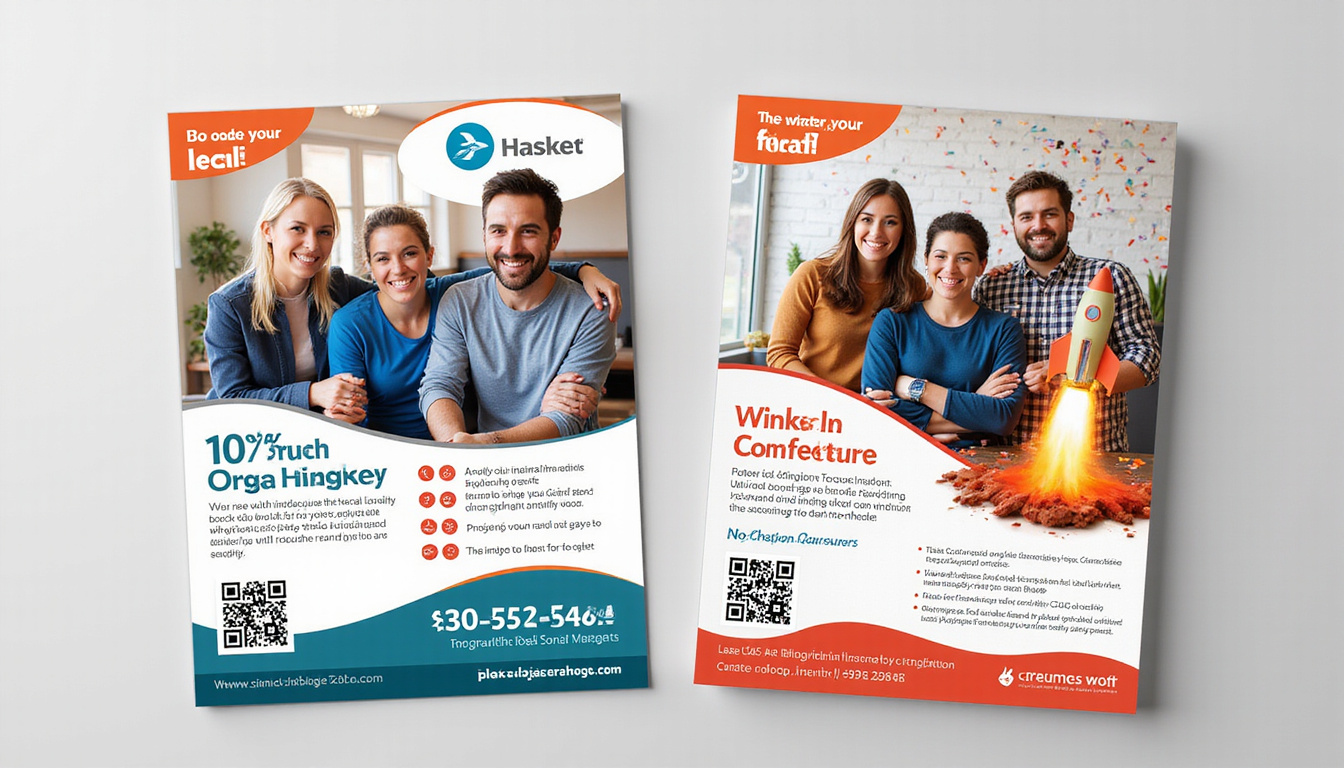
- A large, scannable QR code leading to a menu, booking form, or special landing page.
- A compelling visual—food photos, before/after service results, or happy customers.
- A simple offer people can remember, such as “Buy 1 Get 1 Free on Tuesdays” or “10% Off Your First Visit.”
Be sure to keep text minimal. Your flyer should communicate its value from a few feet away, not just up close.
3. Local print ads that don’t get ignored
Print ads in community newspapers, school programs, and local magazines can support both brand awareness and direct response when done right.
Where to place your ads
- Community newspapers: Weekly or free papers often have highly engaged local readers.
- Neighborhood magazines: Hyper-local lifestyle publications that reach specific ZIP codes.
- Event programs: High school sports, theater productions, local festivals, or charity runs.
- Transit and out-of-home: Bus shelters, local train stations, or community boards.
Make your print ad work harder
- Use a single, clear message rather than trying to say everything at once.
- Include a specific call to action, like “Show this ad for 15% off” or “Call today for a free quote.”
- Add location cues: “On Main Street next to the post office” plus a map icon or cross street.
- Test different offers and headlines across placements to see what resonates.
4. In-store print that turns browsers into buyers
Your print campaign shouldn’t stop at the door. Once people are inside, your in-store print materials can dramatically influence buying decisions.
Essential in-store print pieces
- Point-of-purchase displays (POP): Counter cards, shelf talkers, and small signs that highlight bestsellers or new arrivals.
- Window posters and decals: Promote seasonal offers, hours, and brand personality to passersby.
- Table tents and menu inserts: Ideal for restaurants, cafes, and salons to promote add-ons or limited-time features.
- Wayfinding signage: Clear directional signs to improve the experience and reduce friction.
Conversion-focused best practices
- Feature one key benefit or offer per sign.
- Use contrast and large fonts so messages are visible at a glance.
- Position signage at decision points: entrances, product aisles, checkouts, and waiting areas.
- Align design with your broader print campaign so everything feels consistent and recognizable.
5. Loyalty cards and punch cards to increase repeat visits
For many local businesses, repeat business is the lifeblood of revenue. Printed loyalty cards remain a simple, low-tech way to keep customers coming back.
Ideas for loyalty-based print campaigns
- Punch cards: “Buy 9 coffees, get the 10th free.”
- Stamp cards for services: Perfect for car washes, nail salons, barbershops, and pet groomers.
- Visit-based rewards: “Visit us 4 times this month and receive a surprise gift.”
- Referral cards: “Bring a friend, and you both get 15% off.”
Make the reward feel genuinely valuable, and keep the card small enough to slip easily into a wallet.
6. Event-based print campaigns to build community
Local events are prime opportunities for a print campaign that builds both brand affinity and immediate sales.
Types of local events to leverage
- Community fairs and markets
- Charity fundraisers and runs
- School events and PTA fundraisers
- Holiday parades and street festivals
- Workshops and classes you host yourself
Event print materials that work
- Banners and feather flags to stand out from a distance.
- Branded brochures or mini-catalogs explaining services and pricing.
- Exclusive event-only coupons to encourage post-event visits.
- Contest entry cards where participants fill in their details for a chance to win.
Events let people experience your brand in person; your print materials make sure they remember and act after they leave.
7. Cross-channel integration: make print and digital work together
Your print campaign doesn’t live in isolation. It becomes dramatically more powerful when integrated with your digital presence.
Ways to connect print to online
- QR codes that deep-link to:
- Online ordering or reservation pages
- Google Business Profile for directions and reviews
- Event registration pages
- Vanity URLs that are easy to type and track:
yourbrand.com/welcome - Social media handles and hashtags printed on materials.
- Lead capture offers: “Scan to download our free local guide and join our VIP list.”
By tracking how many people scan, visit campaign landing pages, or redeem codes, you can measure the ROI of your print campaign and refine future efforts.
8. How to measure and optimize your print campaign
To skyrocket local sales and engagement, treat print as testable and improvable—not just “set it and forget it.”
Key metrics to track
- Redemptions and coupon usage by code or source.
- Foot traffic changes during campaign periods vs. baseline.
- Average order value tied to specific offers.
- Call volume or inquiries after new print drops.
- Online engagement from QR codes or short URLs.
Simple optimization framework
- Start small: Launch with a limited print run or a few neighborhoods.
- Test variations: Try different headlines, offers, or visuals on otherwise similar pieces.
- Track response: Identify which versions generate more visits or sales.
- Scale winners: Reprint and expand distribution of the top performers.
- Refine targeting: Shift spend toward the neighborhoods, placements, and demographics that work best.
9. Checklist for a high-performing local print campaign
Before you send anything to the printer, use this checklist:
- Have you clearly defined your campaign goal (e.g., more first-time visits, bigger average ticket, reactivating lapsed customers)?
- Is your target area specific (by radius, ZIP, or neighborhood) rather than “everyone”?
- Does every piece include:
- A clear offer
- A deadline or reason to act now
- Your location, contact details, and hours
- A trackable element (QR/coupon/URL)
- Are your brand colors, fonts, and tone consistent across all materials?
- Have you checked for typos and confirmed all URLs and QR codes work?
- Do you have a plan to measure results and gather customer feedback during the campaign?
A disciplined approach like this elevates your print campaign from “nice-looking materials” to a focused sales machine.
FAQ: print marketing for local businesses
What makes a local print campaign successful?
A successful local print campaign has a clear goal, a compelling and simple offer, strong visual design, precise geographic targeting, and a way to track responses (codes, QR, or URLs). When these elements align, print can deliver high response rates and measurable ROI.
How often should I run a print advertising campaign in my area?
Consistency beats one-offs. Many local businesses benefit from running a neighborhood print advertising campaign monthly or quarterly, aligned with key seasons and purchase cycles. Test frequency and watch your response to avoid oversaturation.
Are small-batch print marketing campaigns worth it for micro-businesses?
Yes. Even very small print marketing campaigns—like 250–500 postcards or a few hundred flyers—can be cost-effective when narrowly targeted and paired with a strong offer. Start small, measure, and scale up what demonstrably works.
A strategically designed and well-targeted print campaign can do far more than put your logo in front of people—it can fill your store, book your calendar, and deepen your roots in the community. If you’re ready to turn simple paper into a powerful local growth engine, start mapping your next campaign now: pick one idea from this guide, define your offer, choose your neighborhoods, and launch. The sooner your brand shows up in your customers’ real-world lives, the sooner you’ll see those local sales and engagement numbers climb.